
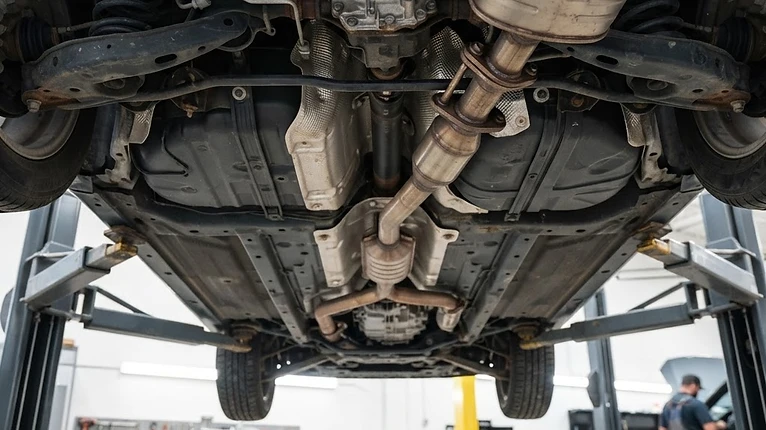
How to Inspect Your Car's Exhaust System Before Winter: A Canadian Guide
Don't let a rusted exhaust ruin your winter. Learn how to safely inspect your car's exhaust system for leaks, rust, and damage before the snow hits.
The Hidden Dangers of Winter Exhaust Issues
When the temperature drops across Canada, we spend a lot of time thinking about tires, batteries, and heaters. However, one of the most critical systems often goes overlooked until you hear a sudden, loud rattle or rumble coming from underneath your vehicle. Your exhaust system works overtime during our harsh winters, battling road salt, moisture, and extreme temperature fluctuations.
Driving with a compromised exhaust isn't just about the noise. It can lead to decreased fuel efficiency, engine performance issues, and, most importantly, safety risks like carbon monoxide leaks entering your cabin. Before the heavy snow falls and crawling under your car becomes a chore, it is time for a thorough inspection.
Why Your Exhaust Needs Extra Care in Canada
Canadian roads are unforgiving. Magnesium chloride and road salt create a corrosive environment that eats away at metal exhaust components. If you notice any of the following, it is time to investigate:
- Louder than usual engine noise: A classic sign of a hole or a cracked manifold.
- Vibrations: Feeling buzzing in the steering wheel or pedals.
- Visible rust: While surface rust is common, scaling or holes in the pipes or muffler are red flags.
- Check Engine Light: Sensors within the exhaust system can trigger warnings if flow is restricted or if the catalytic converter is compromised.
How to Conduct a Visual Inspection
If you are comfortable performing basic maintenance, follow these steps to check your system safely:
- Ensure the vehicle is cold: Never work on an exhaust system after the engine has been running. You will get burned.
- Park on a level surface: Always use proper jack stands if you need to elevate the car. Never rely solely on a floor jack.
- Use a bright flashlight: Start at the engine manifold and follow the pipe all the way to the tailpipe.
- Check the hangers: Ensure the rubber insulators are intact. If they are cracked or broken, the exhaust can bounce and hit the undercarriage.
- Look for soot marks: Black, sooty deposits on the pipes indicate an exhaust leak where gases are escaping before reaching the tailpipe.
When is DIY Appropriate?
It is important to know your limits. You can safely identify loose hangers, clear away minor surface rust, or inspect for obvious holes. However, if you find deep structural rust, major cracks in the catalytic converter, or if the system requires welding, this is a job for a professional. Attempting to repair a rusted-through muffler or manifold incorrectly can result in dangerous exhaust leaks.
How Fixbud Can Help
Not sure if those rusted spots are serious enough to require a shop visit? Fixbud helps you bridge the gap. You can upload a photo of the undercarriage or the specific area of damage. Our system helps assess whether you are looking at minor surface corrosion that you can treat yourself or a structural failure that requires professional attention. We then help you determine the next steps, whether that means a DIY guide for a quick fix or guidance on what to discuss with your local mechanic.
Conclusion
Taking thirty minutes to inspect your exhaust system now can save you from a loud, expensive, and potentially dangerous breakdown in the middle of January. Stay safe, stay warm, and keep your vehicle running right this season.
Ready to see what’s going on underneath your car? Start your Fixbud assessment today and get a clear picture of your vehicle's health.
Wondering if your own repair is DIY-friendly? Start a Fixbud assessment — snap a photo or describe the damage and get an honest, personalized repair guide in seconds.
Comments
No comments yet — be the first.
Comments are reviewed by an admin before they appear.